
Running Memberships? The Rules Are Changing Fast.
Independent trainers and small gyms may already be subject to new requirements around sign-up, renewals, free trials, cancellations and recordkeeping—often without realizing it.
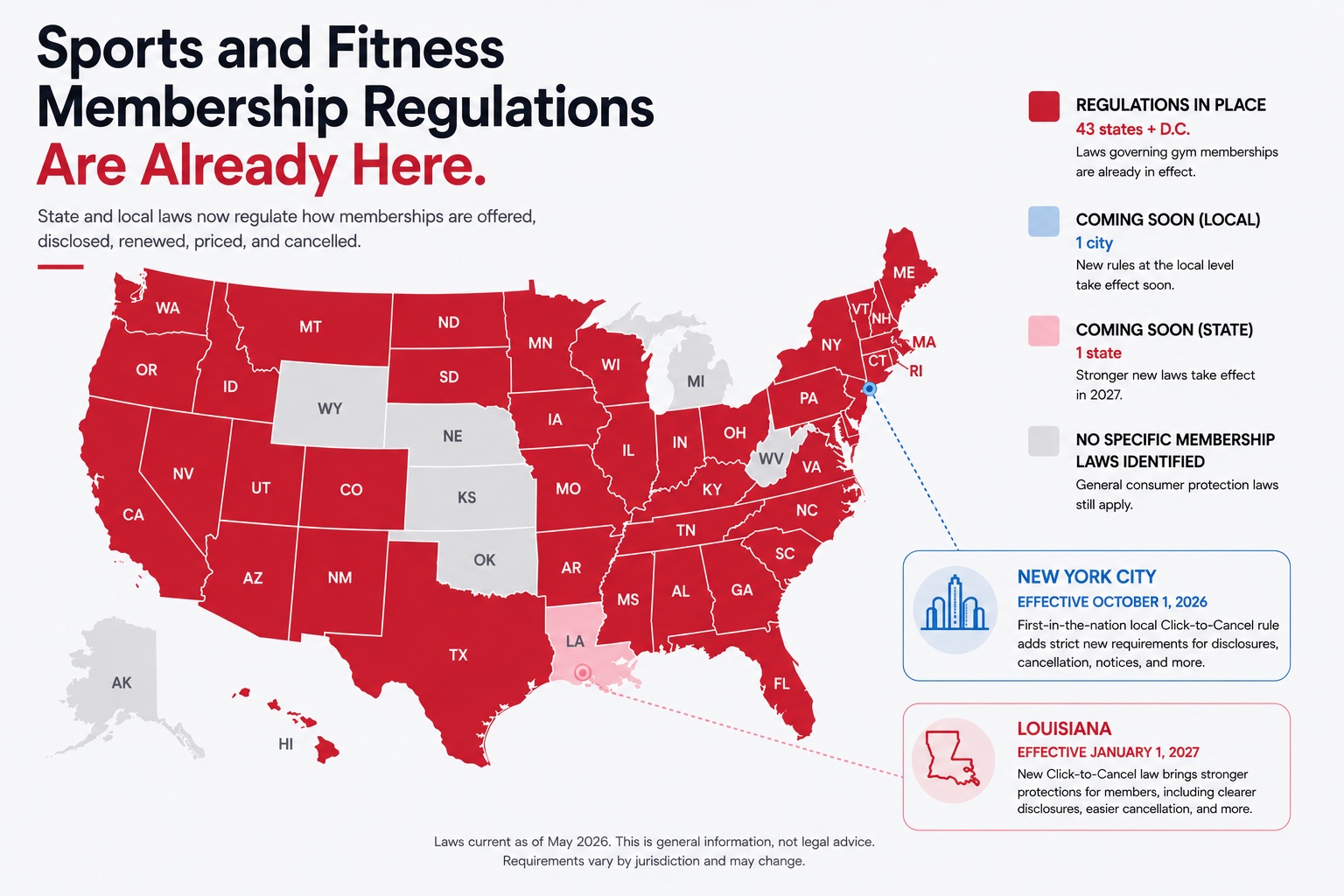
Tap the map to enlarge. Laws current as of the article's publish date and subject to change.
Memberships can be a powerful way for independent trainers and coaching businesses to create more predictable revenue while helping clients commit to consistent training. But recurring memberships also come with rules that many coaches may not realize apply to them.
Over the last several years, states and municipalities have been tightening requirements around automatic renewals, free trials, cancellation, renewal notices and the way membership terms are presented to consumers. New York, California and New York City are good examples of how quickly the landscape is evolving. California strengthened its automatic-renewal law in 2025, while New York has health-club-specific cancellation requirements and New York City's new "Click to Cancel" rule takes effect October 1, 2026.
The federal picture has also changed. The FTC's 2024 Click-to-Cancel rule was vacated, and in 2026 the FTC restored the prior Negative Option Rule while opening a new rulemaking process around recurring payments and cancellation practices.
There is no single national membership rulebook you can rely on. The requirements depend on where you operate, how your memberships are structured, and which laws apply to your business.
That sounds complicated, but most of the requirements fall into a handful of areas.
1. Make the membership terms clear before the client signs up
A client should be able to understand the important terms of a membership before entering payment information or agreeing to the plan.
That generally means making things like the following clear and easy to find:
- What the membership includes
- How much it costs
- How often the client will be charged
- Whether the membership renews automatically
- The length of any initial commitment
- What happens at the end of a free trial or promotional period
- How and when the client can cancel
Some jurisdictions go further. California, for example, requires covered businesses to obtain the consumer's express affirmative consent to automatic-renewal or continuous-service terms before charging them.
This is one reason we designed CoachFirst Memberships so that the terms of the plan are presented clearly as part of the enrollment process rather than buried somewhere else.
2. Keep a reliable record of what the client agreed to
Recurring billing can create disputes months after the original signup.
If a client questions a charge later, you want to be able to answer basic questions with certainty:
- What plan did they join?
- What terms were presented?
- When did they agree to them?
That is why agreement records matter.
CoachFirst stores membership agreements and signup audit records electronically so there is a clear record associated with each membership.
This isn't just useful for compliance. It also reduces ambiguity for the coach and the client if questions come up later.
3. Pay attention to renewal notices
Depending on the membership and jurisdiction, businesses may be required to notify clients before certain renewals.
California requires notice before the automatic renewal of covered plans with an initial term of one year or longer. The notice must be sent within a specified window and include information about the renewal and how to cancel.
New York also imposes renewal-related requirements for health-club contracts, including cancellation rights around annual and monthly renewals.
Beginning October 1, 2026, New York City will add additional automatic-renewal requirements, including notices for certain renewals, material changes and longer free trials.
For a small coaching business, keeping track of those rules manually can become surprisingly burdensome.
CoachFirst is designed to automate membership communications and notices where the platform supports them, rather than leaving the coach to maintain a separate reminder system.
4. Free trials and promotional rates need to be clear
Free trials and discounted introductory periods are useful tools, but they also deserve extra attention because clients need to understand what happens when the introductory period ends.
California, for example, requires advance notice for covered free or discounted trial periods lasting more than 31 days before the membership transitions into a paid automatic-renewal period.
New York City's new rules also require notice for certain free trials lasting more than a month before the first chargeable period.
CoachFirst Memberships allows a coach to define free-trial and promotional-rate periods directly in the plan, while presenting the subsequent billing terms clearly to the client.
That makes the offer easier for the client to understand and easier for the coach to manage.
5. Cancellation is becoming one of the biggest compliance issues
Few areas of membership regulation have received more attention than cancellation.
New York currently requires covered health clubs to accept cancellation through methods including website, email, telephone, mail and in person. If the membership can be entered into through a website, the business must also accept cancellation through the website.
New York City's new rule goes further. Beginning October 1, 2026, the city will enforce a "Click to Cancel" framework for covered automatic-renewal and continuous-service offers, with civil penalties starting at $525 for violations and potential restitution in some cases.
The direction of travel is clear: regulators are increasingly skeptical of cancellation processes that are materially harder than signup.
CoachFirst gives clients a straightforward way to review and manage their membership, including cancellation according to the terms of their plan.
That reduces work for the coach while giving the client a transparent experience.
6. Clients should be able to understand where they stand
Not every good membership practice comes directly from a statute.
A client should not have to email their trainer to answer questions like:
- How many credits do I have left?
- When is my next payment?
- Which services does my membership cover?
- What card is being charged?
- What have I already paid?
- Can I get a receipt?
CoachFirst makes that information available directly to the client.
That transparency is good customer experience, but it also supports the same principle that underlies much of the new regulation: recurring relationships should be clear and understandable.
Why is all of this regulation happening now?
A lot of the new attention around memberships and automatic renewal is a response to practices consumers have disliked for years.
Difficult cancellations. Surprise renewals. Trial periods that quietly turn into paid subscriptions. Terms that are technically disclosed but difficult to understand.
The fitness industry isn't unique in this regard, but gym memberships have become one of the most familiar examples of the problem.
For independent trainers, there is an opportunity to approach the issue differently.
Most independent coaches build their businesses around long-term trust. Their clients stay because the coaching is valuable and the relationship works.
The membership experience should reinforce that trust rather than undermine it.
Clear terms, reliable records, predictable billing and straightforward cancellation aren't just compliance requirements. They're part of running a professional coaching business.
That's how we built CoachFirst Memberships
When we designed Memberships, we didn't want to simply add recurring payments and leave the rest to the coach.
We built the broader membership workflow around the things a coach and client need from beginning to end:
- Clear plan terms during enrollment
- Electronic agreement and audit records
- Flexible billing cycles
- Free trials and promotional-rate periods
- Automated recurring payments
- Client visibility into upcoming and past payments
- Membership-credit tracking
- Automated membership communications
- Pause and resume functionality
- Straightforward cancellation according to the plan terms
The goal is to let independent coaches take advantage of the business benefits of memberships without also taking on a second job administering them.
Explore CoachFirst Memberships
The rules will keep changing
One reason this area deserves attention is that the regulatory picture is still moving.
The FTC reopened federal rulemaking around recurring payments and cancellation in 2026. New York lawmakers are considering further changes to health-club cancellation rules. New York City's new requirements take effect October 1, 2026.
That means this isn't a topic most coaches can review once and forget about forever.
We don't think independent trainers should have to become experts in subscription regulation to run a membership program.
They should be able to focus on coaching while using tools that are designed with these requirements in mind.
Memberships built for independent coaches. Finally.
This article provides general information only and is not legal advice. Membership requirements vary by jurisdiction and business circumstances.
Back to Articles