
Set Profitable Prices and Packages That Build Client Commitment
A step-by-step, numbers-first approach to pricing your training services and packaging them so clients stay committed.
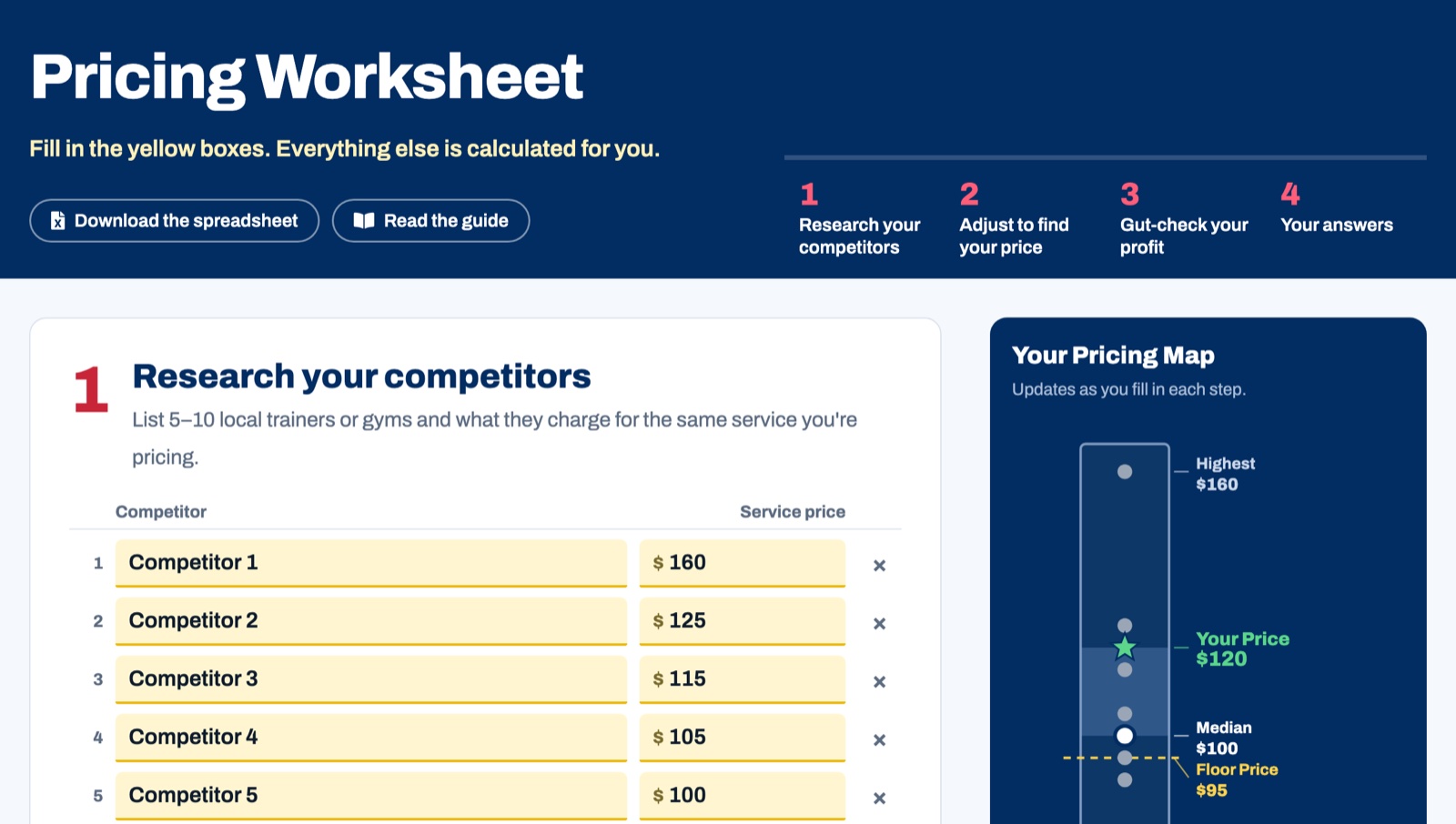
Creating or refreshing the pricing and packages for your training service is both 1) one of the most important decisions you make for your business and 2) almost always more emotional than it should be.
Rallying cries like “Know Your Worth!” reinforce the emotional side of pricing decisions and miss the point, no matter how well-intentioned that advice may be. Many trainers struggle with confidence (or over-confidence), and that leads them to set their prices far too low (or high).
Emotion can’t answer the two big questions when it comes to pricing the services you offer:
- What should my packages and pricing be?
- How do I figure that out?
This article and the Pricing Worksheet will answer both of those questions, taking emotion out of the equation. Yes, there’s some basic math involved. Pricing is a numbers game, after all.
At the end of this exercise, you will have:
- The pricing and packages for your training business
- The knowledge of how you stack up in your market
- The confidence to support your pricing based on the value you deliver
- A clear understanding of how your pricing makes your training business profitable
Let’s get started!
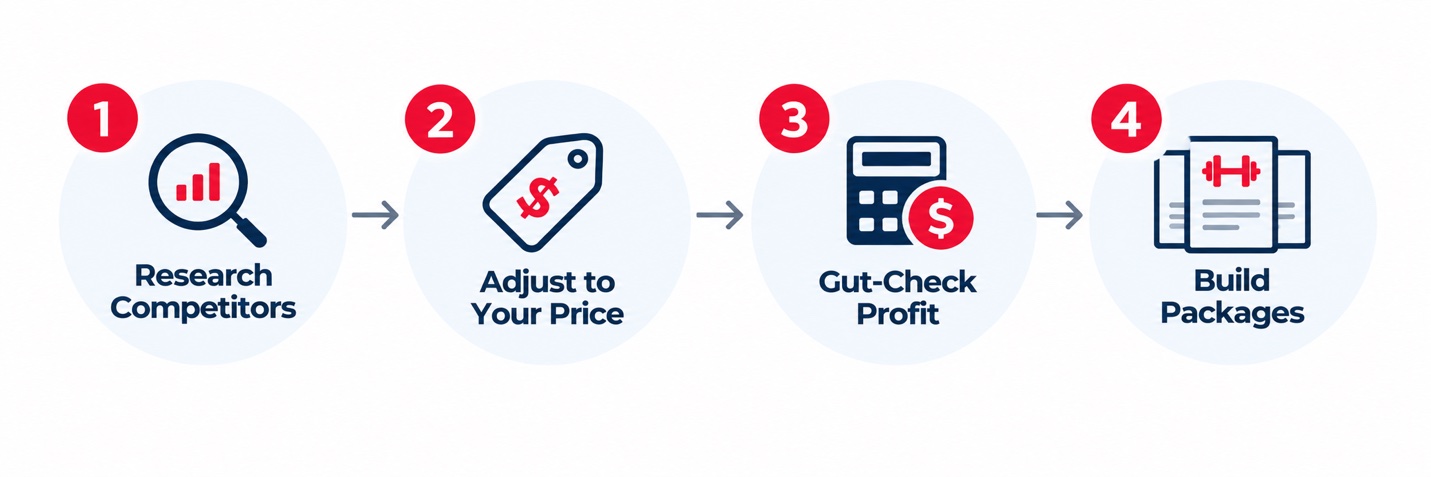
Your Guide to Pricing: The Pricing Map
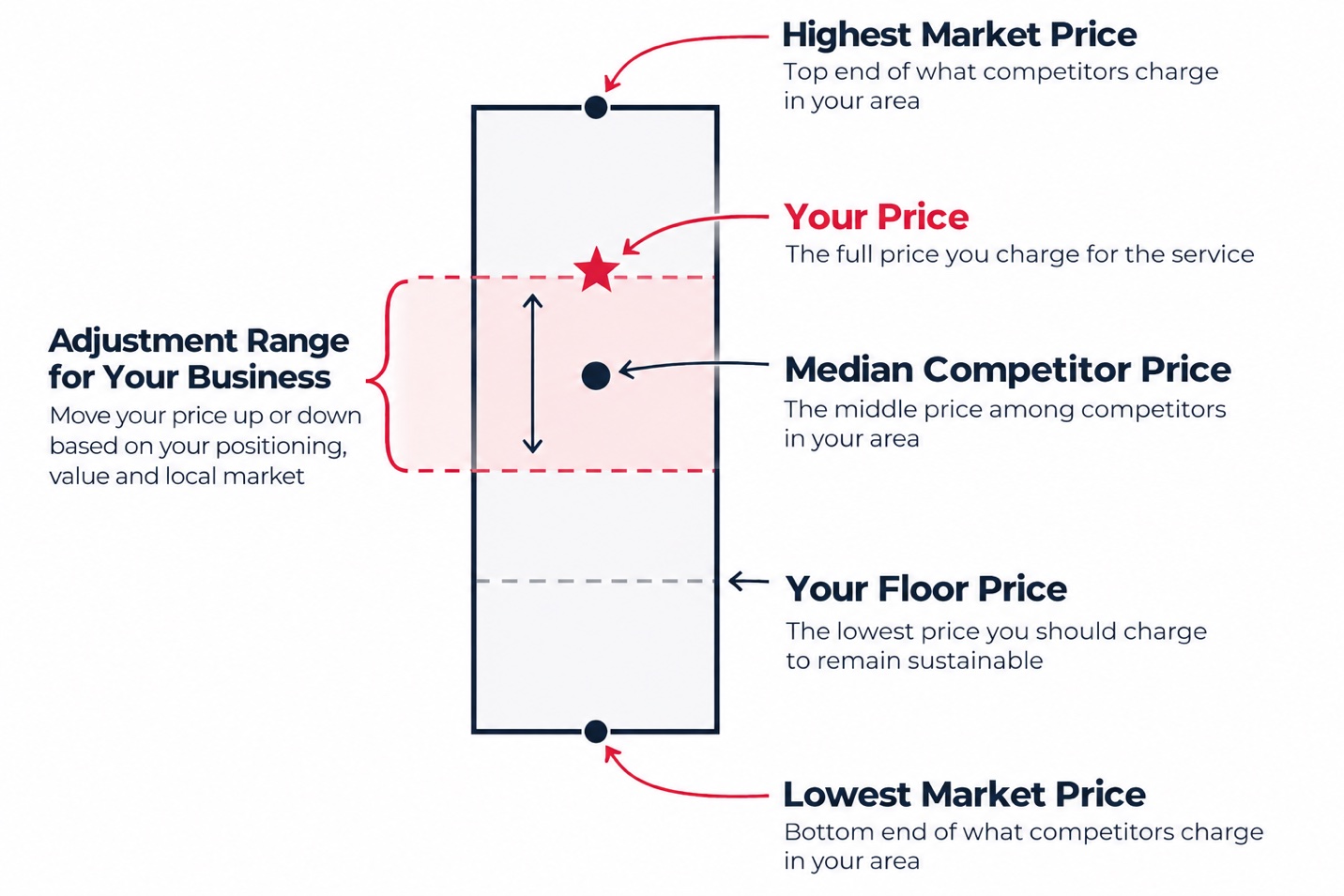
To know where you’re going on pricing and packaging, you need a map. A Pricing Map.
The Pricing Map ultimately tells you four things:
- The range of prices other trainers in your market charge
- The price you can’t go below and still run a profitable business (your Floor Price)
- How you stack up against the competition in your market
- Your target pricing
Here’s what the Pricing Map looks like:
Now let’s walk through the steps to create the Pricing Map for your business.
Step 1: Competitor Research
Every great coach scouts out their competition, and you need to do the same.
You’re looking for 5–10 training businesses in your market that offer the same service you do. If a prospective client were looking for a personal trainer in your town or neighborhood, who would they consider? That’s your competition. If you’re pricing a one-hour private training session, find out what those businesses charge for it. Once you have that information, stack them from lowest to highest, like this:
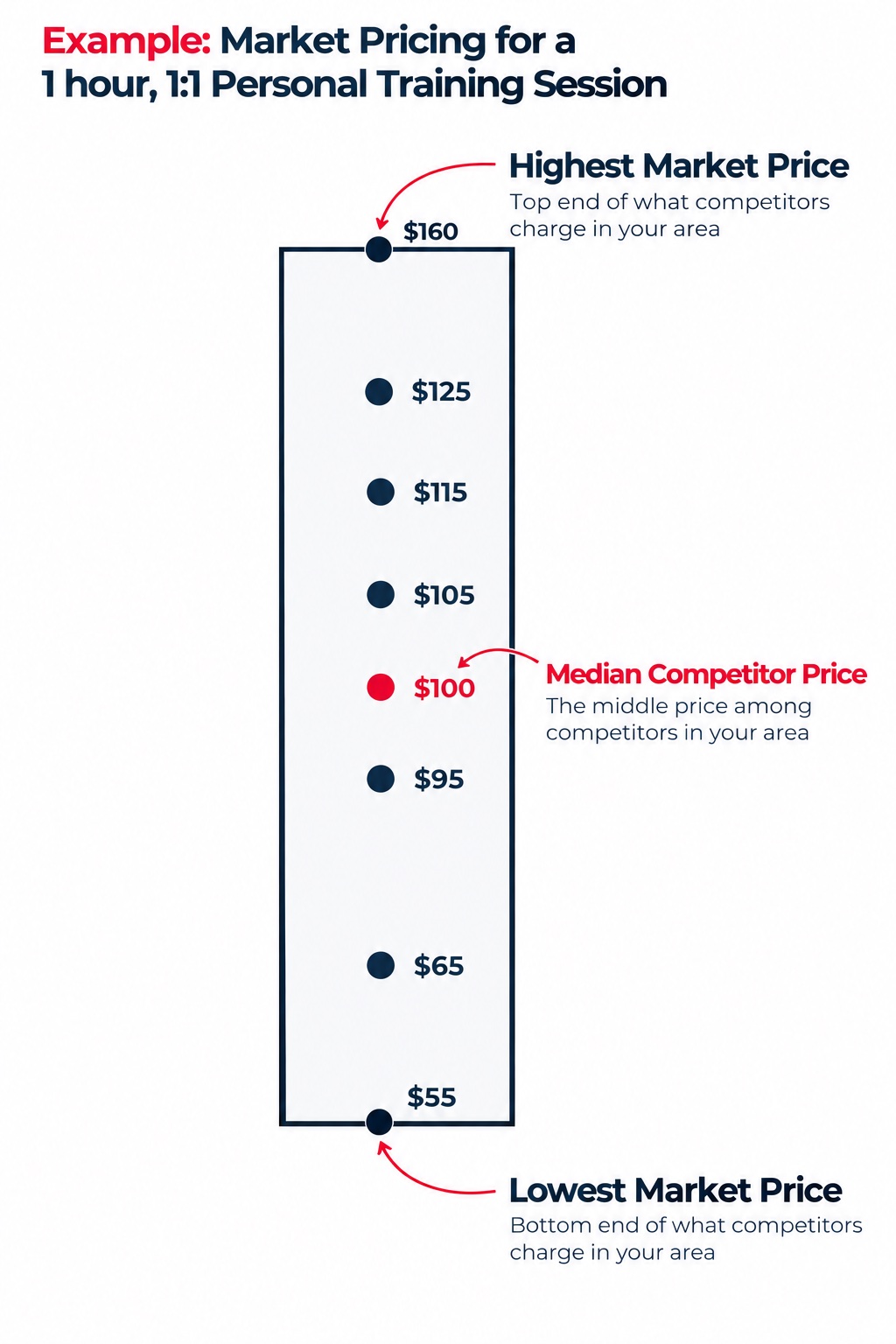
Congratulations, you now have a good view of the market you’re competing in! The price in the middle of the range is the median price in your market, and it’s your starting point for the next step.
Note: why use the median instead of an average? One or two exceptionally low prices, like $65 and $55 in our example, can artificially drag down your starting price. Don’t let the outliers drive your pricing!
Step 2: Adjust from the Median to Find Your Price
Now that you know what your competitors are charging, it’s time to figure out your own pricing.
Your starting point is the median price of your competitors, which you found in the previous step. Next, you adjust that price up or down based on the factors that are specific to your business and how you stack up against your competitors on factors other than price. These factors fall into two categories:
- Objective Factors: these factors are measurable with real numbers (e.g., 95% of your available hours are booked each week) or observable facts (e.g., you asked five clients for testimonials and all of them said yes)
- Subjective Factors: you need to use your judgment to assess these factors, and it’s important to be honest with yourself. Examples would be “My location sees more foot traffic and has better parking than that gym across town” or “Everyone in this area knows Abby is the best strength coach in town, but I’m not far behind her.”
To use the factors to make adjustments, assess your business on each one using a simple scoring method like this:
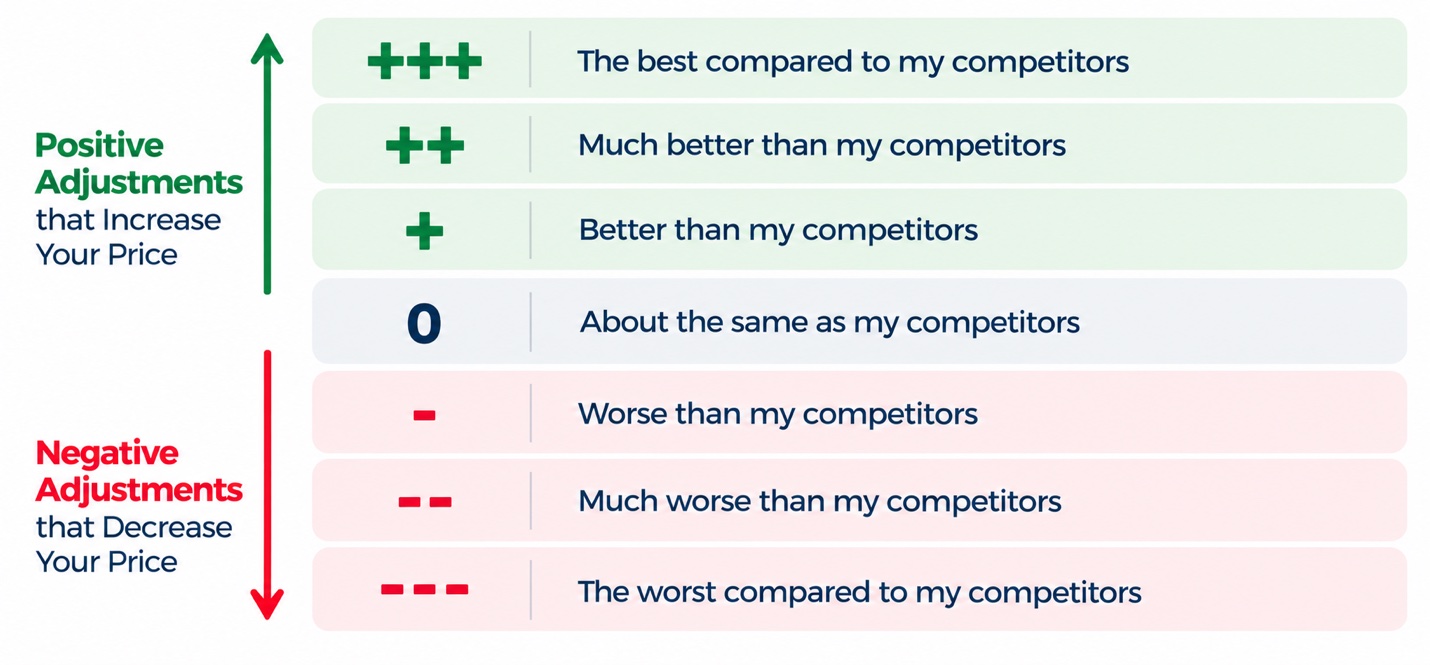
The factors below are common ones, but there may be others that matter in your market.
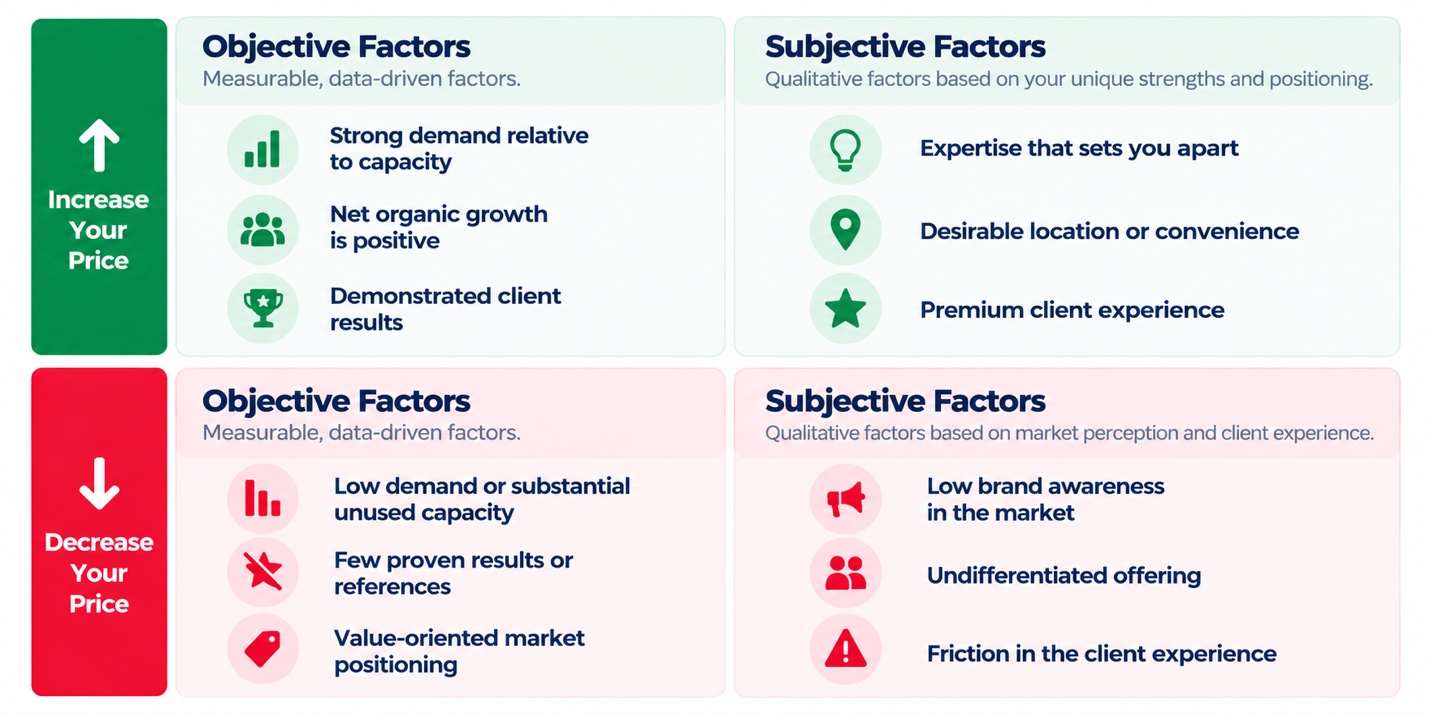
Price Increases: Objective Factors
- Strong demand relative to capacity: Your calendar is consistently close to full, particularly during desirable training hours, and you’re regularly turning away prospective clients or maintaining a waitlist.
- Net organic growth is positive: The number of organic referrals you have had in the past 3 months that turned into active clients is higher than the number of clients who have left over the same period.
- Demonstrated client results: You have a strong track record of helping clients achieve measurable goals, supported by testimonials, referrals, retention, or documented progress.
Price Increases: Subjective Factors
- Expertise that sets you apart: You’re known as the best trainer in town for women in their 40s, youth athletes trying to make varsity, or you’re the GOAT for fixing back or shoulder problems.
- Desirable location or convenience: Your gym is located in a high-traffic area, it’s easy to get to before or after work, it’s near public transportation, or it offers free, easy parking.
- Premium client experience: Your facility is sparkling clean and clients are energized to be there, there are always fresh towels that smell like lemons, and booking and payment are seamless.
Price Decreases: Objective Factors
- Low demand or substantial unused capacity: You have significant availability, few incoming leads, and limited organic referrals.
- Few proven results or references: You don’t yet have testimonials, referrals, or a meaningful history of client outcomes to support a premium price.
- Value-oriented market positioning: You’ve intentionally built a no-frills business for price-sensitive clients, with a low cost structure that supports competitive pricing.
Price Decreases: Subjective Factors
- Low brand awareness in the market: Your space is only accessible through an unmarked door down an alley, you have no online presence, and prospects have no way to find you. No one knows you’re there.
- Undifferentiated offering: Your training services are largely interchangeable with those of other local trainers, without a clear reason for clients to choose you at a higher price.
- Friction in the client experience: You’re slow to respond when prospects reach out, clients can never find parking near the gym, you only take cash. No matter how good your training is, these things annoy clients.
Now that you have your adjustment factors, adjust your price up and down accordingly. While we would love to give you an easy-to-apply formula for these adjustments, you will need to weight their relative importance and quantify them. We will say this: numbers rarely lie, and using subjective factors to paper over problems the objective factors reveal is a fast way to fool yourself.
To continue our example, here are the adjustment factors for our example business:
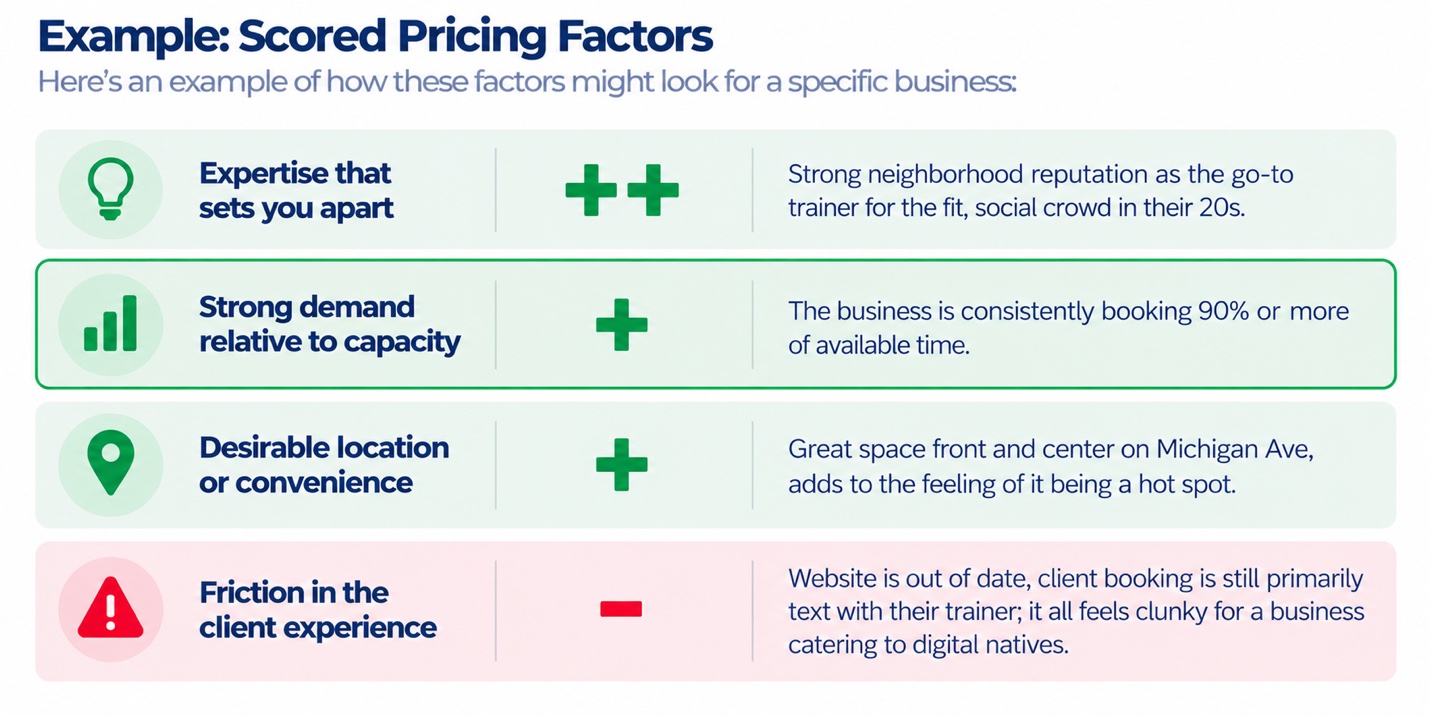
Let’s see where those different adjustments leave our example business:
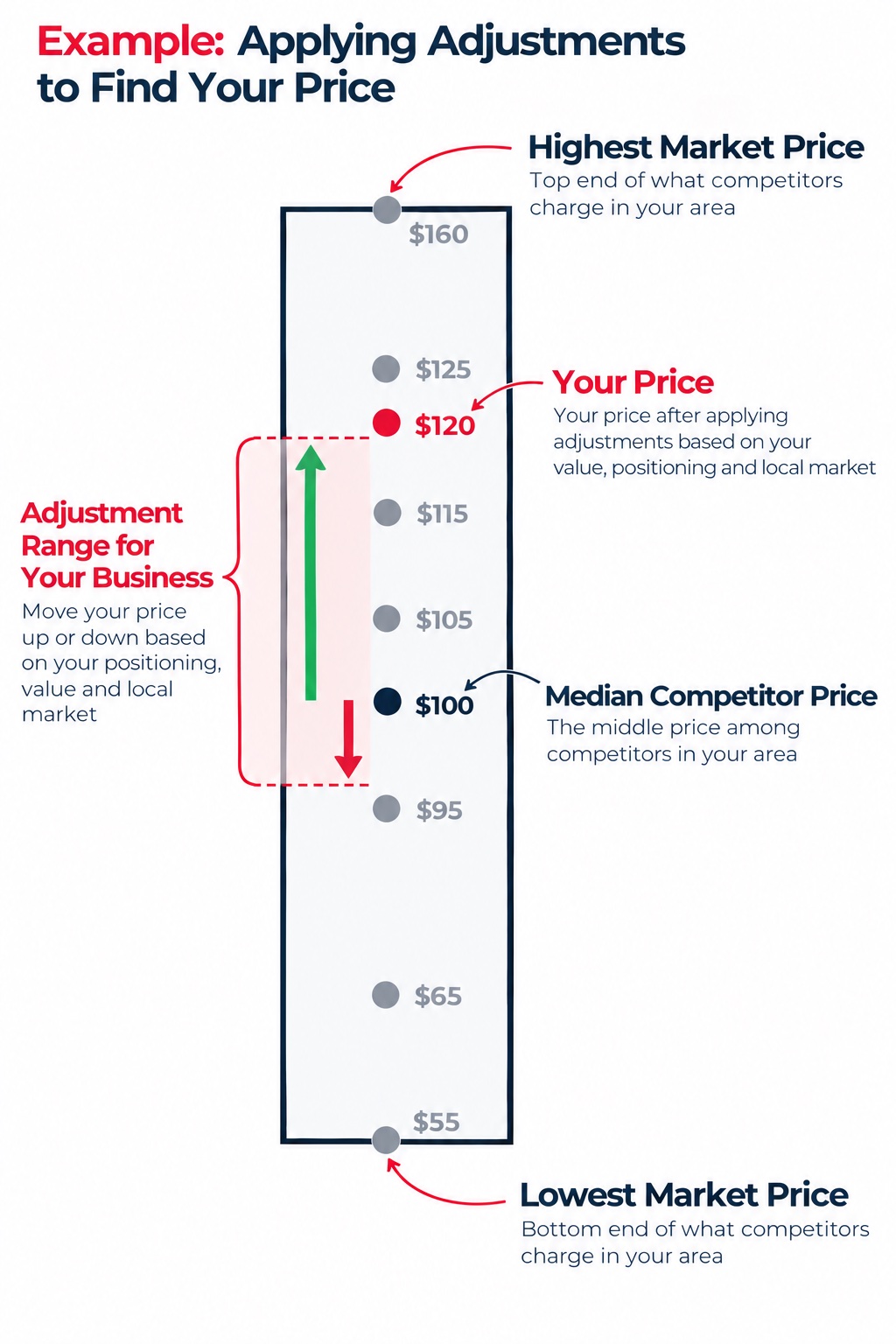
High demand is the single biggest factor in setting prices. In this example, the negative impact of the unnecessary friction from the client experience is outweighed by other positive factors, giving this business the ability to price at a premium compared to most of its competitors. Add a great tool like CoachFirst to give clients a digital experience they love, and this business could be pricing at the top of the range!
Step 3: The Gut Check – Is Your Pricing Profitable?
You have your target pricing, and you can confidently support it in the context of your market. But can you make a living at this price point?
Here is a step-by-step way to find your Floor Price and make sure your pricing is profitable:
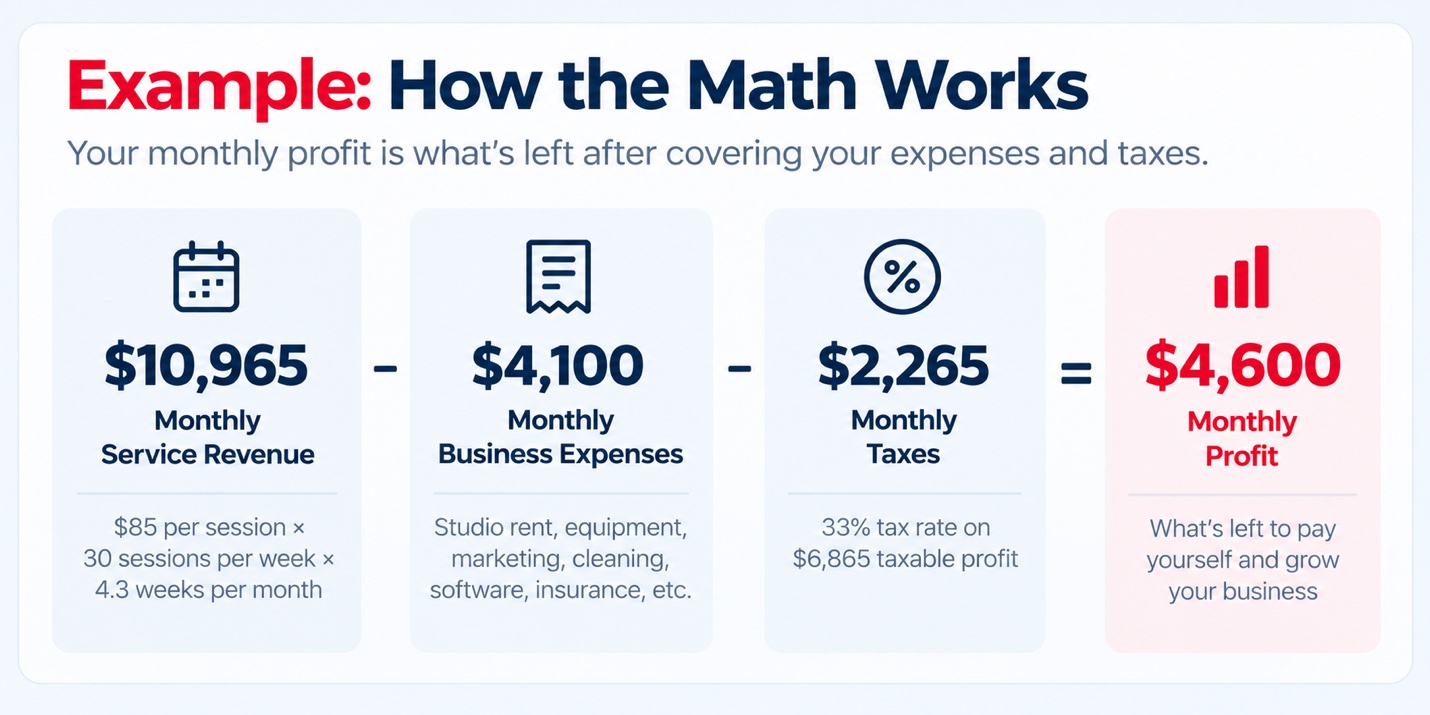
Revenue: Calculate Your Monthly Service Revenue
Let’s switch to a different example:
- You’re a newer independent trainer whose Pricing Map puts them at $85 per session.
- You run a personal training business that only offers one-hour private training sessions.
- You typically book 30 training sessions per week.
- Assume there are ~4.3 weeks in the average month.
Monthly Service Revenue = $85 × 30 × 4.3 = $10,965
Expenses: Add Up Your Monthly Business Expenses
Gather all of the monthly expenses for your business and add them up. Don’t leave anything out; it’s essential to have an accurate number, or you may end up setting your prices too low!
| Studio rent | $2,500 per month |
| New equipment and supplies | $500 per month |
| Marketing | $500 per month |
| Cleaning services | $250 per month |
| Software (this could be $0 if you use CoachFirst!) | $150 per month |
| Other business expenses (insurance, email, etc.) | $200 per month |
| Total Monthly Business Expenses | $4,100 |
Taxes: Calculate Your Monthly Taxes
- Your business tax rate is ~33% combined for federal and state taxes
Monthly Taxes = ($10,965 – $4,100) × 33% = $6,865 × 33% = $2,265
Profit: Calculate Your Monthly Profit
Monthly Profit = $10,965 – $4,100 – $2,265 = $4,600
Floor Price: Is Your Profit Enough?
The moment of truth: is the Monthly Profit a number that works for you? That number pays your rent or mortgage, buys your groceries, supports your family, and pays for your next vacation. Is it enough? If the answer is “yes!” then you have Your Price, and you can move on to packaging your services at that price.
But if the answer is “no” or even “maybe,” it’s time to do two things:
- Find the Floor Price above which your Monthly Profit becomes a “yes!”
- Support that pricing by improving your business
Find Your Floor Price
To find your Floor Price, adjust your pricing until your Monthly Profit reaches your desired Monthly Profit (the Pricing Worksheet makes this easy without needing to run all of your numbers again).
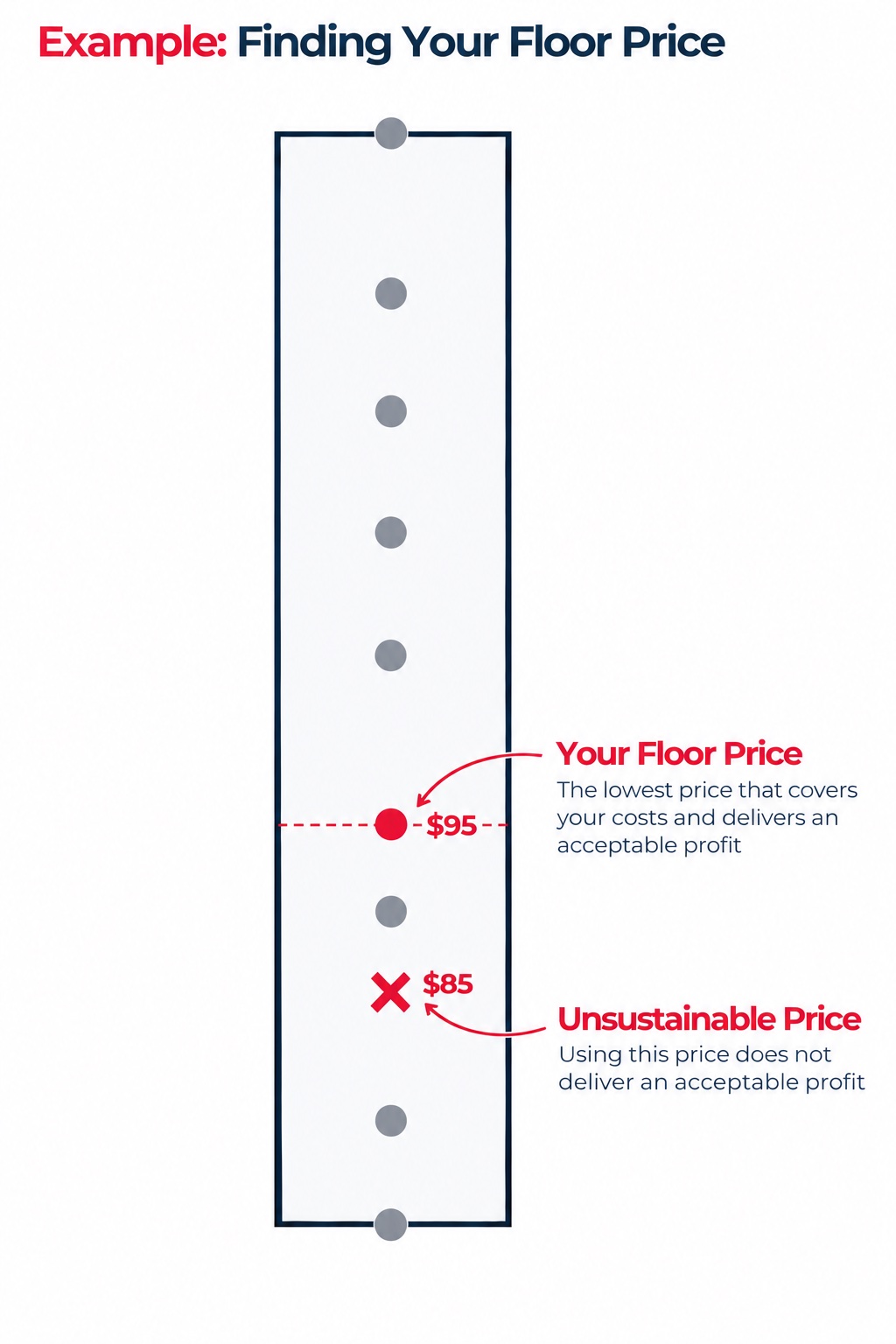
- The Monthly Profit you need is $5,400
- Using the Pricing Worksheet, you find your Floor Price is $95 per session
Support Your New Price
In this example, the price increase is only $10 per session, from $85 to $95. If you have a full calendar of committed clients, you can probably make that change with no problem.
If the price you need to charge is significantly higher, or you’re already struggling with keeping clients and filling your calendar, the mission is different. Go back to the adjustments that decreased your pricing power and decide which ones you’re going to work on to improve the value clients get from working with you.
Step 4: Create Packages that Drive Commitment
Nice work – you did the math, and now you have a price for your service! Now it’s time to package your services around that price and get clients on board.
Success in a coaching relationship comes down to one thing: client commitment. If a client is committed to doing the work, they will see results and keep working with you. That commitment is the vehicle that delivers value to the client, and revenue and pricing power to you.
That’s why your packages should be designed around the commitment they create.
3 Different Packages, 3 Levels of Commitment
Here are three packaging examples:
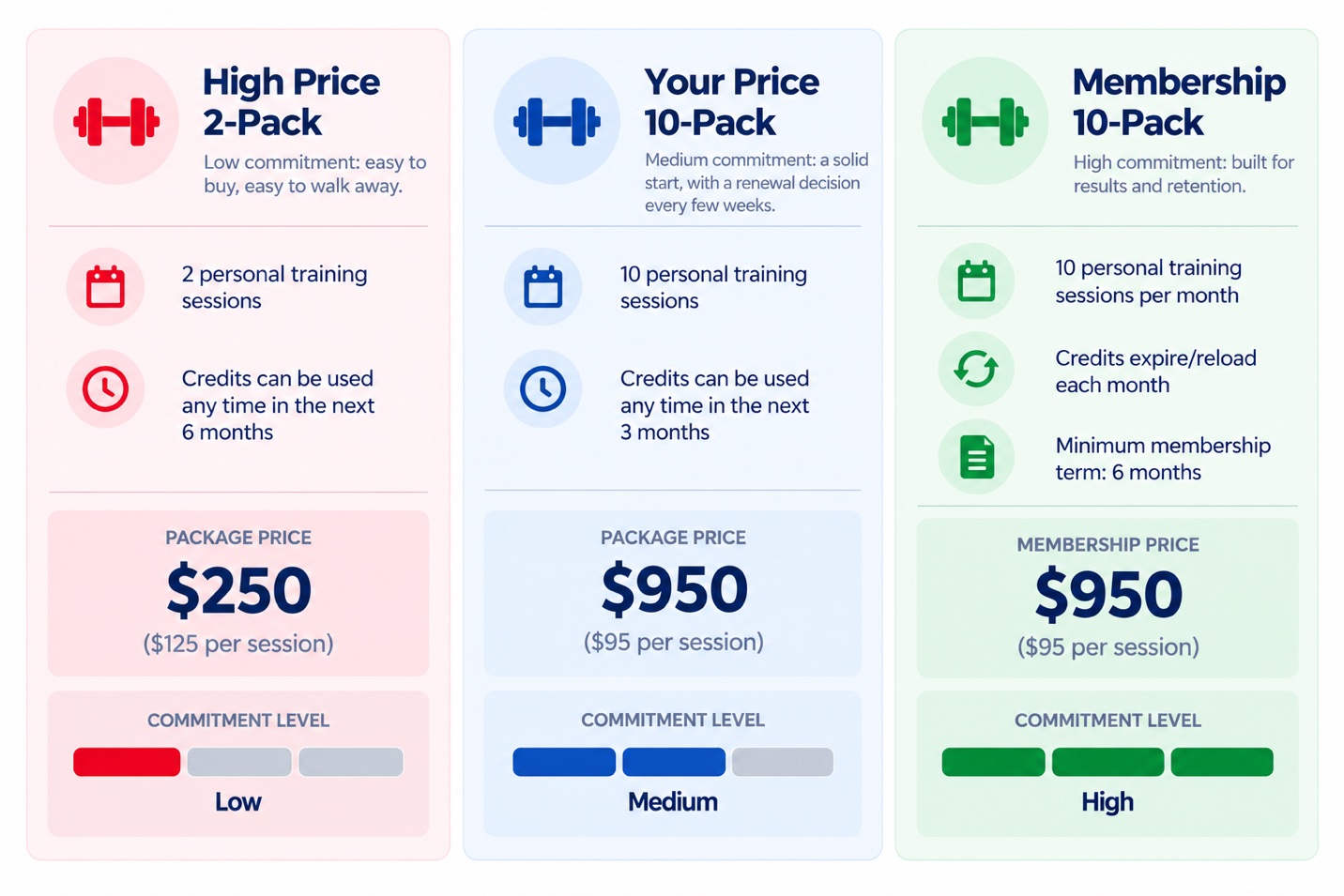
3 options, 3 different levels of commitment. Let’s analyze each one:
#1: High Price 2-Pack
If your standard price is $95 per session, why wouldn’t you sell a package that gives you $30 more per session? Because it comes with a lack of commitment from the client. In two sessions, they won’t see results or establish a habit, which makes them an immediate retention risk. By buying this package in the first place, they’re telling you they’re not committed.
#2: Your Price 10-Pack
Buying a package of 10 sessions indicates a higher level of commitment, and this could work. If the client buys this package and you schedule them for recurring sessions twice a week for 5 weeks, they can start to feel results and get into a sustainable rhythm. If that’s the plan, shorten the credit expiration to match. Even then, you’re selling them another package every five weeks, which makes each renewal a new decision for them, unless you move them to a better option…
#3: Membership 10-Pack
This drives ongoing commitment! When a client signs up for 6 months, with 10 sessions a month, that indicates they’re serious. Why no discount off your regular price of $95 per session?
Committed clients value your services and are willing to pay for them.
If you lower your price, you will attract less-committed clients. Learn more about using memberships to run your business here and here.
Free Assessments and Discounts
Free or discounted introductory sessions can be an effective way to attract new clients, but they should serve a specific purpose: turning interested prospects into long-term paying clients.
If your goal is simply to learn about a prospect’s goals, explain your approach, and determine whether you’re a good fit, consider offering a free 15–20 minute consultation. It’s a relatively small investment of your time. Be clear and confident when communicating the commitment needed from them and the value you can deliver for them.
If you want prospects to experience what it’s like to train with you, consider offering a discounted full-length session instead. Charging something reinforces that your time and expertise are valuable, even when you’re offering an introductory price. If a prospect is unwilling to sign up for regular training after this session, that’s a red flag that they’re a low-commitment headache waiting to happen.
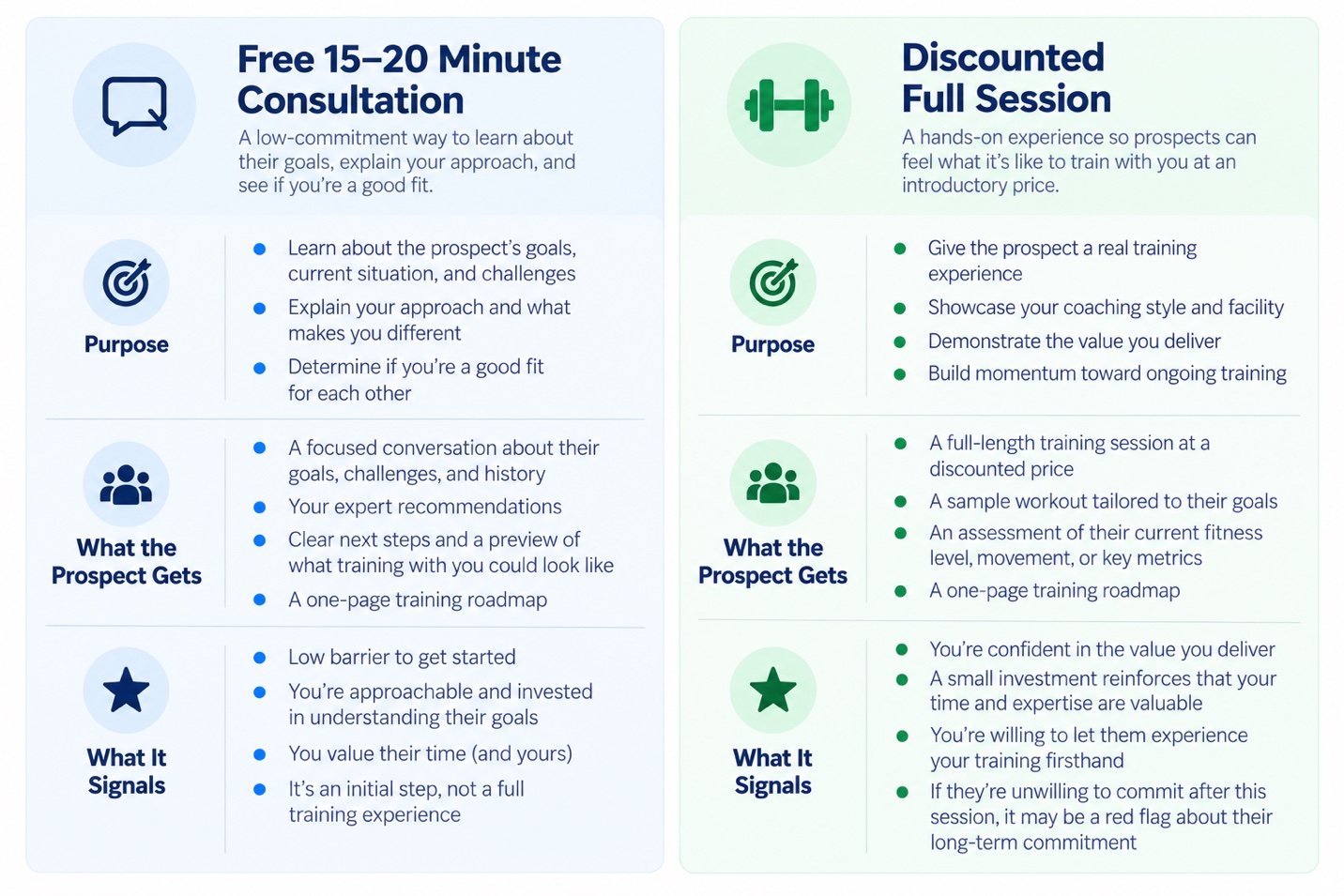
Whether it’s a free consult or discounted session, you can demonstrate your value by giving the client something tangible as part of the session. An introductory assessment might include a sample workout, an evaluation of their starting point, and a one-page training roadmap outlining recommended training frequency, pricing, and a realistic timeline for achieving their goals.
Remember: introductory pricing is a client-acquisition investment, not your standard price. Track how many prospects become ongoing clients to make sure that investment is paying off.
Put Your Pricing to Work
Now that you have done the hard work to set your pricing and packaging, let’s make the rest easy. CoachFirst makes setting up your services and packages simple, and automates everything from membership management to credit reminders for packages. So whether you’re starting out and creating your first package, or a seasoned coach looking for better ways to run an established business, contact us to learn more about how our team can help.
Back to Articles